Welcome!!!

BYBYNJ@gmail.com

www.reesepaintings.com

"The true painter strives to paint what can only be seen through his world." ~André Malraux


After a year of intermittant "painter's block"  I am working again in my studio, and feeling in a tentative positive state. Painting is a solitary activity, and as artists, we are often working in a vacuum. Unless we have a show hanging, reaction to the work is minimal. With several pieces underway, I decided that perhaps if I write about what I am doing or am attempting to do, it might act somewhat as a muse for me as well as give me some feedback on the work I am creating -- hence the establishment of this blog. 

As for the blog title, traditional, representational painting is a language for expressing what’s visible. But I feel my work is the most successful, and most interesting, when focused on things not entirely visible. I paint what I see but also what I sense and feel by utilizing my interior and unseen world --- in other words, the invisible world. Plein air work or  studio work from photographs are only touchstones or landmarks which guide me to other inner spaces. By so doing, I find that I am pushing the boundaries between representational and abstract work.

You can enlarge the images in this blog by clicking on them.


Jul 14, 2011

Venice: A Work of Art Unto Itself

Photo by Bob Buzas (son-in-law)
The start of our two week trip to Italy to celebrate my husband’s and my 70th birthdays was our two days in Venice, undeniably one of the world’s most glorious cities. I had not been to Venice since 1962, and it was my husband’s first trip to the magical city -- with it's glorious blend of water, art and romance situated so close to the Adriatic Sea. Created more than 1,000 years ago by men who thumbed their noses at the sea, and built their splendid Venetian Gothic palaces and churches on mud banks in a swampy and treacherous lagoon, it’s a true treasure of architecture, art and atmosphere. We reveled in the unique atmosphere of the canals and boats, the panoply of museums, bridges, churches and sunlit squares and everywhere, flowers. 
Photo by Bob Buzas
 The whole city is an extraordinary architectural masterpiece in which even the smallest building contains works by some of the world's greatest artists such as Giorgione, Titian, Tintoretto, Veronese and others.

 With only two days there, and with four grandchildren between the ages of 5 and 10 in our group, we obviously did not see and do everything. While the others climbed the Basilica di San Marco, John and I took the slow vaporetto #1 down the length of the Grand Canal enjoying long, extended view of the major waterway of the city, and took in the wonderful ambiance of Venetian life unfolding on the Grand Canal.

We stopped off at the Accademia Gallery which houses the most magnificent collection of Venetian art in the world. Over the centuries, the great masters of Venetian painting adorned the city with wonderful works imbued with light and color, a quality that has distinguished the Venetian school of painting since its origins, I am sure because the city itself is so light splashed and luminous. The collection at the Accademia Gallery illustrates the evolution and characteristics of Venetian art, including the fourteenth century Byzantine-style Madonnas and the great canvasses by Gentile Bellini and Carpaccio that record fifteenth century Venice.  As my 10 year old grandson later remarked when in one of the Italian art museums, “…there are a lot of Marys and Jesuses there.”

Feast in the House of Levi by Paolo Veronese
One of the most interesting works of arts at the Accedemia is Veronese’s painting which is now known as the Feast in the House of Levi, completed originally for the rear wall of the refectory of the Basilica di Santi Giovanni e Paolo in 1573. The painting was originally intended as a depiction of The Last Supper, and was titled thusly, designed to replace a canvas by Titian that had been lost in a fire. It measured more than five meters high and over twelve meters wide (at 42 feet long, one of the largest canvases of the 16th century), and was a culmination of Veronese's banquet scenes, which this time included not only the standard characters of The Last Supper, but also German soldiers, comic dwarves, and a variety of animals. 

When Paolo Veronese unveiled this enormous painting, it was shocking not only for its size, but also for its rather raunchy depiction of the Savior and his pals. But as Veronese's use of color attained greater intensity and luminosity, also his attention to a narrative interplay and emotion among his beautifully rendered figures was becoming tantamount to his creations. And here, the artist had portrayed one of the holiest of moments in the bible as a drunken banquet that conjured up, to some, paintings of Roman orgies!

So, because the subject, and title, of this rather racy painting was The Last Supper, it was noticed by the increasingly Puritanistic powers-that-be in the Inquisition which was exerting its influence in Venice at this time. Quite simply, they had a fit over the painting, and very speedily in July of 1573, Veronese was summoned to explain the inclusion of “extraneous and indecorous details” in the painting. The church charged the painter with irreverence—and threatened to indict him on the very serious charge of heresy. Veronese explained that "we painters take the same liberties as poets and madmen."House of Levi". 

The inquisitors suggested several changes to the painting, probably relating to the removal of Germans and buffoons etc, but in the end nothing at all was changed and a very Italian solution was negotiated - the work was retitled The Feast at the House of Levi. The scene still had Jesus in it, but a Jesus surrounded by guests who were free to engage in acts of secular glee and gluttony—and the mollified censors let it pass!


We also, all ten of us, visited the Doges Palace, or Palazzo Ducale, an extravagant Gothic Renaissance palace that symbolizes the glory days of Venice.  The Doge’s Palace, created of white limestone and pink marble, was softened by porticos, finely wrought loggias, a crenellated roof and a series of balconies by Pier Paolo and Jacobello Dalle Masegne,  was the seat of the government of Venice for centuries. It looks like dessert! The system of elected doges was as singular as everything else about this very singular city, and lasted for 1000 years. As well as being the home of the Doge (the elected ruler of Venice) it was the venue for its law courts, its civil administration and bureaucracy and — until its relocation across the Bridge of Sighs — the city jail. In spite of the heat, we marveled at the Golden Staircase and ornately decorated walls and ceilings covered by works of great artists including the world’s largest oil painting, the 23x75 foot Paradise by Jacopo Tintoretto.

Upstairs we walked through the doge’s private rooms to the Anticollegio, where the doge and council would meet foreign dignitaries. The Anticollegio is decorated with four Tintorettos; his work and Titian’s  dominate the walls, although the Sala del Consiglio dei Dieci has works by our old friend the almost-heretic, Veronese; and the Sala dell’Armamento has the remains of Guariento’s fresco, Paradise, wrecked in the fire.

The kids loved walking out over the Ponte dei Sospiri (Bridge of Sighs, constructed 1602) to the city’s ‘new’ prison. 
My grandchildren looking out over The Bridge of Sighs--- their father who took the photo says : "We need one of these at home!"

 Before it was built, prisoners were kept in the eaves of the doge’s palace, (the Piombi or ‘leads’) or in the cellars (the Pozzi or ‘wells). Wherever, it must have been horrible, and the kids loved hearing about it.

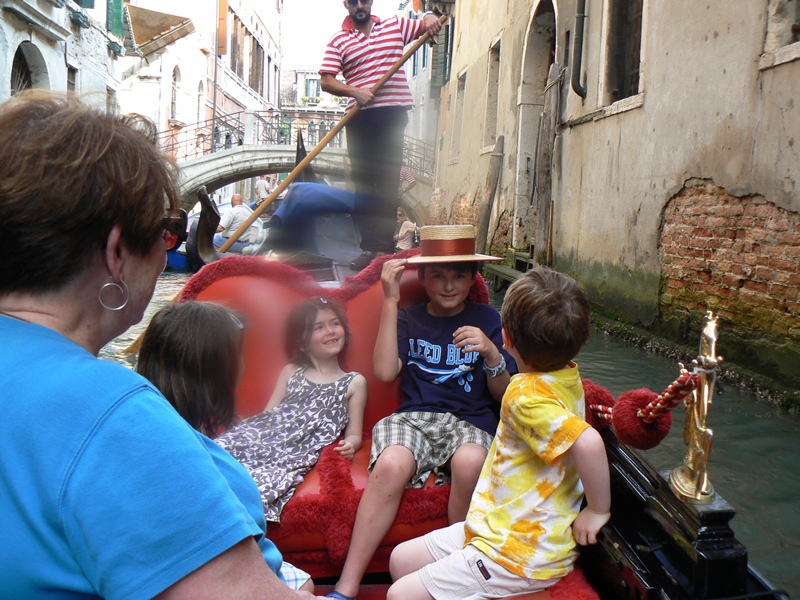
The rest of our short time in Venice, we fed the pigeons in San Marco Square, walked over the picturesque bridges, had a drink at water’s edge, and took our grandchildren for a gondola ride down the back lagoons and canals of the city, which everyone enjoyed. John and I enjoyed an elegant dinner at the Hotel Danieli, but otherwise we ate the delicious food in everyday places.

Eloise with the pigeons, Photo by Bob Buzas

View from Gondola, photo by John Reese

Grandson Aidan wearing Gondolier's hat. Photo, John Reese

          If ever a city itself was a work of art, this is it.

Arrivi Derci Venezia! GranddaughtersLily and Eloise carting their suitcases to the water taxi, causing quite a stir wearing their souvenir masks. Photo, Michael Reese


Jun 10, 2011

Colors and Shows

I think I almost remember the first box of Crayola crayons my mother got for me when I was very young. The expanse of colors I saw when I opened the lid, the distinctive aroma that to this day, 65 years later, carries me back to childhood, made my heart race faster. I had love affairs with some of the colors, and I remember crying because I used up the Magenta stick in endless pictures of ballet dancers I made. I still have love affairs with colors, and after our trip to Sedona this spring, have been entranced with the organic Indian reds, siennas, and all of the terra cotta and golden hues of that magical place. I have not yet created any canvasses from the many shots we took of the Sedona rocks, but I will. Getting our many gardens in shape has occupied much of my time in May, hence no postings.

But I did complete one painting last week of southwest pottery, which incorporates many of these colors. I foresee a future series, perhaps without a unified subject matter, but with the purposeful use of specific colors to tie the work together. I like this painting because it features the colors of the southwest, and also creates rather mysterious shadows, hidden recesses as well as openings, much as my long ago giant close up paintings of roses did, leaving the viewer open to imagination. I was able to utilize my penchant for texture and layering in this piece, combining realistic pots in a surrealistic manner which I hope creates an appealing composition.
Still untitled   26" x 22"
Last week I was trying to complete a couple of very tiny
3” x 3” gallery-wrapped canvases with painted edges.  These are for an art exhibit in early July to kick off our town’s 250th anniversary. The show is to be held at the Justin Morrill State Historic Site, the gem of our little village. It is a remarkable place showcasing his interest in horticulture, politics and scholarship, and Justin Morrill was a remarkable American. Through his educational legislation and vision, Morrill changed our world, our nation and our lives. There are 105 Land-Grant colleges and universities in the United States with over 25 million graduates worldwide. Morrill was the longest serving person in Congress ever when he retired from the Senate, and was a true humanitarian whose life and legacy is fostered and preserved through the efforts of the Friends of the Morrill Homestead. I was on the board for six years, and now John has taken my place.

The Homestead
The barn to the left is where the art show is held.
Anyway, the tiny paintings are part of a “Minis for Morrill” sale to raise money for the site. They will be shown on tiny easels, and sell for $25 apiece. All artists in the show were asked to contribute one or two of these minis. (You can see another person's results if you click on Andrea Doughtie's blog link to the right.) I found it an incredibly challenging effort to produce anything in such a tiny size. I have done 5” x 5” and 6” x 6”, but somehow this smaller venue was harder! I came up with the following two pieces.
Water's Edge # 5  oil on canvas  3" x 3"
"Happy Pig" oil on canvas  3" x 3"

For the show itself, titled “A Sense of Place,” I am taking the Hay Bales painting seen previously in this blog, and a fall scene, shown below, in a rather poor photo, especially the top half. This piece depicts fall in our beautiful area, which fits in with the show’s theme.


“Woodland Inlet in October” is 24” x 48”

(I later removed this painting above from the show because it sold before the show went up. That's nice! I substituted another one.)


I also had to take two paintings to a show in my Lyme, NH gallery for an exhibit celebrating THEIR 250th anniversary! These were the abandoned house shown in this blog previously called “All Gone, All Gone” and an older piece,  shown below.
“Marsh at Quechee Gorge” a 36” x 24” oil  on canvas 
 And I still need to come up with two to enter into the AVA Juried Show, which are due this weekend!

On Tuesday John and I are leaving for New York and the next day for Italy with our entire family, kids and grandkids, for a combined 70th birthday celebration. A few days in Venice, a week in Tuscany in a rented villa with a pool, another extra day in Florence, and then John and I go on to four days in Rome. So once again, the blogging may be sporadic!

May 19, 2011

A Post Without a Picture

  I do not paint by (or live by) any hide-bound formulas. I cannot copy someone else's color palette or mixing formulas and make it work for me. I find that my paintings cannot come from the outside --  they must come from the inside – from what is not entirely visible to anyone else. What I have learned over the years has now become second nature, and much of the time I could not begin to tell you what I am doing as i paint or why. And absolutely whatever I have learned and internalized is the result of MANY failures, which still happen with much regularity, probably because I do not use any formulas!  I paint like I cook.  My color awareness is intuitive. I would be hard pressed to write down any formulas or exact proportions.  It's like cooking to taste rather than following a recipe.

Perhaps because I am so recently returned from the red rock country of Sedona, I am feeling the need to play around with earth tones in the studio this week. I have not yet begun a painting of the scenery we saw in Arizona, but I am working with  that palette in my latest  painting which is an abstracted close-up composition of unglazed terra cotta ewers and pots.

I am reaching back to what I learned in my color theory class those many years ago at Skidmore (most of which I have forgotten)  as I mix my terra cotta  reds and the complimentary greens and blue greys ---  one pot will be a warm, dark earth red with a tendency towards blue; another with hints of viridian in it, and another almost white. You can buy pre-mixed tubes of paint with names like red ocher, red oxide, Mars red, terra rosa, red earth, but I am just using cadmium red medium cadmium yellow medium for a warm oranges, and adding hints of ochre or burnt sienna, and using complimentary  greens to pull out the brightness of the terra cotta. 

For this painting, I have on my palette a warm red and a cool red (Cadmium red medium and Alizarin); a warm yellow and a cool yellow (Cadmium Yellow Medium and Light and also Ochre); a warm blue and a cool blue (warm is Ultramarine, and cool is Cobalt) as well as staples Burnt Umber, Burnt Sienna and Titanium white. But then I added a few more --- as far as I am concerned, using only a few or using a lot of paint colors is neither a good thing or a bad thing. Sometimes a few extra colors already in the tube can help you save time you need to get a painting that really sings. In this case, to my basic palette I added Viridian green, Old Holland’s warm grey, a translucent lake orange and before I end this painting I will be mixing something to get black--- maybe two complimentaries like Alizarin and Viridian, or Phthalo blue and umber, not sure yet, but I will be needing some very dark  “lowlights,” as my hairdresser says, in this painting. I find I'm constantly discovering more nuances and colors with my mixing, and I begin to think after 55 years of oil painting that the combinations and possibilities are inexhaustible!

I like to use a lake paint for the final glazing.

I most often build my paintings from dark to light because I find that applying purer light colors over the darker glazes, when done successfully, creates a warm luminosity in paintings and makes them zing.  However, in this particular painting, the white pot was done just the opposite--- dark over light. I guess I am not very good at living by rules. The result is a continuous accidental learning which constantly shapes my life! Many of my successes I term "happy accidents."

The painting is not yet ready to show by a long shot. But it will appear here in due time. Because I am going down to Connecticut to a family wedding this weekend, and because the gardens are needing me right now whenever it does not rain, it may be a while before I have progressed enough on this painting to show it to you.

May 15, 2011

Building A Faery House With Nate

Gramma and her youngest grandchild.
After Arizona, we traveled to New York for a long weekend with old college friends of mine, and then spent a little time with my enchanting five-year-old grandson Nate. One of his favorite things to do is build faery houses, and we did just that ... 

We situated it nestled  in between a tall tree and a large rock. First he collected small flat stones for the floor which we "grouted" with his sandbox sand. Then came a wall, and then the roof made of bark and twigs.
We stacked some wood outside for their fireplace, which still has to be built.

Taken by holding camera INSIDE the house!


 That night while Nate slept, the faeiries came to occupy their new house, and guess what --- they brought a tiny rocking chair which Nate discovered in the morning. 
The trip to Sedona and this little jaunt is why I have not been in my studio for a few weeks. I hope to remedy that tomorrow. The gardens here are beckoning, but the rain is supposed to continue, so tomorrow will be a painting day.


May 11, 2011

Arizona Highways

Until he died when I was 17, my grandfather lived with me, and my parents when I was growing up in Essex Fells, NJ. One of the things that endeared me to Pop, along with 1,000,000 other things about that dear man, was that he got a lot of great magazines which he shared with me ---  Saturday Evening Post, National Geographic, and Arizona Highways. I  remember sitting in a big comfy chair in the living room of our tall-ceiling-ed old house, pouring over the slick covered magazines, especially the beautiful photographs in AH of what looked like cowboy-land to me --  full of cactus and red, gold and purple rock formations, desert blooms, Native Americans -- and hoping that someday I would get to see it.

Well, it took me 60 odd years, but I finally got there. My husband and I spent a week in Sedona, AZ in red rock land to celebrate my birthday. We had a stupendous time amidst the magical rocks and high desert country. I did not paint while there, but took a lot of photos -- I have been ruminating over how to attempt to translate this glory of color, form and texture onto canvas.

We walked among these monoliths on the Broken Arrow Trail (Jeep access only)


Schnebley Hill Road if you can call it a road had magnificent views
Almost more amazing to me was the day we spent among the Sinaguan Indian ruins, cliff dwellings, and rock sites where they lived over a thousand years ago.The Sinaguas were excellent weavers and successful farmers, occupying the area of central Arizona between Flagstaff and Sedona from 700 - 1400AD, when a drought may have forced them to leave their pit house villages and cliff-side dwellings. Thus the name Sinagua, or sin agua, Spanish for “without water”. However, they are still among us, having blended with the Hopi, Mogollon and Pueblo peoples. These drawings are located within what they believe was a ceremonial fire pit under a rock roof. I stood there with just a few other people gazing at them, and felt so connected with the people who had stood there and made these drawings. It was a very spiritual and emotional moment for me.

Experts claim that the figure upper right is a female fertility symbol giving birth to all of the depicted animals.


Of course these pale besides the French cave paintings. The earliest European cave paintings date back to  32,000 years ago!. The purpose of the paleolithic cave paintings is not known. The evidence suggests that they were not merely decorations of living areas, since the caves in which they have been found do not have signs of ongoing habitation. Also, they are often in areas of caves that are not easily accessed. Some theories hold that they may have been a way of communicating with others, while other theories ascribe them a religious or ceremonial purpose. I suspect they were also a way for these long ago ancestors of ours to express their creativity. (See samples below of this magnificent artwork.)


The level of artistry in these cave paintings has always astonished me. I would so love to see these, but I do not think they let tourists in anymore.

I have to believe that what made these ancient people draw and paint is the same thing that makes us do so today.

Apr 20, 2011

Tamworths

I waved goodbye to my daughter and 5 year old grandson today. They came up for a few days to ease me into my 7th decade, a very hard job, but they sweetened the ordeal. One of the things we did was visit nearby Hogwash Farm, where John and I get our meat in a kind of CSA plan. As I expected, the Tamworths are having babies, and there were at least three litters of tiny piglings to watch. They were delightful, and it bothered me not just a little to know that some of those babies may end up as bacon on my table next year. But I do know that their lives will be good, and the end humane: does that help? Just a little. In any case, they are darling, and the three of us enjoyed visiting with them, and scratching the bristly heads of the mama sows. I took photos of some of them some years back (see above) before to doing a series of paintings of them, and I need to take my camera back there soon so I can paint some more. Two of these small paintings (5" x 5") were actually given to Nancy who runs the farm, in exchange for meat. I love bartering!

Tamworth I  oil on paper on canvas
Tamworth II oil on paper on canvas

Pig in Water  oil on paper on canvas
When I get back from Arizona (we are going for a week, also to help ease me into my 7th decade!) I will get busy in the studio with more forsythia and more pigs. Plus I am sure I shall bring back with me much inspiration from Sedona, and many sketches and photos to take to the studio. In the meantime, here's to the next decade. (Photo is me at my birthday dinner at Simon Pearce with a lovely Kir Royale.)

Apr 15, 2011

Unwrapping Bright Spring

Because it is so emblematic of early spring, and because it is joyfully everywhere this time of year, it is hard for me to believe that Forsythia is such a relatively recent arrival to the United States, coming only about 100 years ago. A native of eastern Asia, forsythia is part of the Oleaceae (olive) family. The genus in English is named after William Forsyth who oversaw the Kensington Palace gardens in the late 18th C. In Korea, where the shrub is known as goldenbells, there is a legend about the forsythia which has made it a symbol not only of the first sign of the return of spring but also of returning love. Legend has it that a married man went on a long journey and after being away for many years, he had begun to take his wife for granted. When he returned home, he found his wife waiting patiently for him in the garden, and he was struck by how beautiful she was. He wrote a poem which he sang to her that said while forsythias and apricot blossoms may bloom and fade, “in the bamboo shade of my mountain home forever abides my Love, my All.” 

With no forsythia in my landscape yet, I spent the week imagining, and painting them. This one, taken from a photo in my daughter's yard, is about finished. I tried to keep it loose and open, layering colors and texture. Hopefully the forsythia is singing out from the painting, with everything else fading into the background, as that was my intent. I have also included a few details of the painting which show the brushwork better.

"Unwrapping Bright Spring "  18"x18"    oil on canvas
Detail # 1

Detail # 2

I wish you all a very happy spring.


Apr 8, 2011

April

I wish winter and snow would just take a final bow and get off the stage. After the April Fool snowstorm, we had yet another day of the white wet stuff on April 5th. Fortunately, it was mixed off and on with rain, so the end result was probably less snow on the ground than when it started. This will make Amy Huyffer happy, who with her husband runs the organic creamery up here in Strafford. She says her cows (with the new calves coming in one by one) are longing to get out and eat some grass. I think there is more snow in our little village than anywhere else in the Upper Valley.


Across the street, which is south facing, I begin to see patches of bare ground dotting the hills, bigger every day. Not so for us, but the snow is starting to shrink away from the tree trunks and the pond egress, and the driveway is bare for the first time since before Christmas. The pile by the front door is down to about 6 feet high. Soon I will hear the waterfall which runs with runoff until mid summer. Being born and bred in New Jersey, traditionally April is when I expect to see crocus and daffodils, when lawns and gardens get raked out and fertilized, and color graces the yards with forsythia and other early blooming shrubs. Not so here. I wrote a poem for this time of year back in 2003 when we invaded Iraq, which is appropriate for this spring as well.

  March 20, 2003

The earth turns under winter-weary snow,
thrusts off its white, wind-carved quilts
and stretches
to the warmth of lengthened days.

Welcomed home
by still sleepy voices of brooks and ponds,
winter’s watery leftovers serpentine down
through snow on softened hills.

The season shifts,
as the world trembles,
and I stand in wonder
that at such a time
Spring can come again.


At least the discouraging weather (and my delightful lack of commitments this week) gives me lots of time to paint. I have three pieces going -- one is probably the last winter piece I will do this year, a  winter farm scene of hay bales in a barn, which I think is working out well. I am laying on layer after layer of color, and concentrating on composition and lights and darks. I wish it would dry faster--- if it did this is one I think I could have done alla prima, because I painted over an old painting, so there was a good base already there. This is an argument for switching to water-based oils, but the financial outlay in paints would be enormous. I cannot seem to get good photos of the work I am doing (for instance the snow is not flat white, but variated), but here it is, best as I can do.

Still Smelling of Dusty Summer   30 x 24  oil on canvas with tissue underlay 
I was also reworking a seascape, but it is still not working and may go to the paint over pile. And I started my first spring piece of the year-- forsythias!  If I can't see them here in April, I can at least paint them. I did a whole series of forsythia paintings some years back, such as this one which was framed later as a triptych. They have all sold except for one tiny one of which I have no photo.


"Forsythia x Three"  18 1/2 x 6  framed, oil on canvas with tissue underlay 

Now that I am painting regularly again, I decided I better get working on having a show or two. I just contracted to have another show at Dartmouth Hitchcock Medical Center Rubin Glass Hallway, my most favorite alternative place to show up here. The woman in charge dispensed with the application since I was already vetted when I had a show there back in 2006, right after my mother died. I do not know when it will be, probably not until 2013. I would like to get something else lined up for early next year if possible, but not sure where yet.  

Apr 2, 2011

Strafford ARTWORKS Show

I have been busy organizing the Strafford ARTWORKS show at the Ledyard Gallery at Howe Library in Hanover, NH. We have 14 of our members in the group show, "Recent Work in Mixed Media." My job was and always is, publicity, and this is the release I sent out, which explains what Strafford ARTWORKS is, for those of you who do not know.

Strafford, VT---  The Howe Library Ledyard Gallery is celebrating the artistic diversity of visual artists from Strafford Vermont with a group exhibit featuring over 35 works.  The 12 eclectic artists from Strafford ARTWORKS have mounted a large show, “Recent Works in Mixed Media,” at the gallery on the mezzanine floor at 135 Main Street in Hanover, Hew Hampshire. The show runs from April 1 through the 27th., with the library gallery open Mondays through Thursday from 10-8, Friday from 10-6, and Saturday from 10-5..The artists will welcome visitors to the Opening Reception on Saturday April 2 from 2 PM to 4PM.  Artist members with work in this exhibition are Jennifer Brown, Marcia Bushnell, Micki Colbeck, Andrea Doughtie, Nancy Gerlach, Tracy Gillespie, Nat Hemenway, Janet Farley, Cecily Herzig, Kate More, Jason Okai,  Mary Louise Pierson, Anni Praetorius and Deborah Frankel Reese. The current show has been curated by Dick Ridgeway and member artists Micki Colbeck, Nancy Gerlach and Anni Praetorious.

Strafford ARTWORKS is an eclectic group of professional artists working in varied mediums including pastel, watercolor, ink, acrylic and oil paints, block prints, monoprints and photography. The broad mix of artists and disciplines has attracted an equally broad demographic of audience members. Individuals from the group are represented by galleries in the Upper Valley, in New York, New Jersey and Massachusetts, as well as in Canada, England, France, Spain and Macau. 

According to Deborah Frankel Reese, one of the founding members of Strafford ARTWORKS, "When we first decided to exhibit as a group about eight years ago, we wondered how our collective work would look together: would our varied artistic visions form a cohesive whole? We were surprised at how well the different media and styles worked together, and it has only improved over the years. When walking around the current show at the Howe, each piece will lead you to the next, as in conversation: Traditional oils -- including exacting still lifes and landscapes by Andrea Doughtie, the colorful Tuscan landscapes of Kate More, the plein air Vermont vistas of Nancy Gerlach, and Jennifer Brown's bright watercolors blend well with the flinty, more contemporary work from the creative inner visions of Janet Farley, Cecily Herzig, Jason Okai, Mary Louise Pierson and Anni Praetorious. Large paintings by Marcia Bushnell and Deborah Frankel Reese containing strong colors and powerful compositions transition seamlessly to the smaller, purposefully-limited palette pieces of Micki Cobeck’s stunning Delft series. Block prints by Tracey Gillespie provide graphic counterpoints, as do the strong photographs of  Nat Hemenway.

"Baby Spiders Are sleeping Under Your Bed"  Cecily Herzig
"Col di Val d"esta" (Tuscany) oil by Kate More
"Delft in Blue" oil, Micki Colbeck


 StraffordARTWORKS was formed nine years ago
by a group of Strafford artists with a shared commitment to studio practice and exhibitions of their work. Representing a mix of mediums, backgroundss, experience, and ages, the diverse and vibrant community of artists meet on an informal basis to critique current work, discuss contemporary art, plan shows, hold workshops and provide a supportive artistic community, especially for those artists who produce their art in isolation. As well as in ARTWORKS group exhibits, such as this one, held at least once a year, in shows held by individual members and in the galleries which represent them, examples of the work by Strafford ARTWORK members can be seen on Open Museum at http://www.openmuseum.org/museum/show/29, a virtual on-line museum spotlighting the work of artists.  If you join the site, you can go to the Strafford ARTWORKS "Museum" and vote for the work that you like, a helpful tool for artists who too often work in a vacuum. Information about the organization can be found on Open Museum’s website. For more information, please contact Deborah Frankel Reese at BYBYNJ@gmail.com

The show was expertly hung by a pro Dick Ridgeway and two of our artists Friday --  somehow we managed to get the 35 pieces there in spite of the snowstorm. The Opening Reception on Saturday went well: we had a good turnout, good reactions, and so far three pieces have been sold. Some of the work in the show is shown above. Below are a few shots of the reception, the only ones that I can get off of my iphone so far.

My work in the show


Work by Janet Farley

Work by Micki Colbeck, left, and Marcia Bushnell, right.


Person viewing work by Nancy Gerlach and Jennifer Brown.

Person viewing work by Anni Praetorius.    


Mar 31, 2011

Like Grass Under the Wind

I received a Facebook friend request this week from a retired teacher in York, ME where the writer May Sarton spent her last 20 years, thanking me for starting the May Sarton page on FB. There is going to be a big celebration for what would have been her 100th birthday up there in 2012, and I intend to go. As well as working in the studio, I have been dipping into her poetry recently. Her journals, for which she is arguably best known, have nourished and sustained me over the years, but her poetry, for which she most wanted to be remembered, can also at times be well worth a read. Her poetry is uneven -- she is no Mary Oliver: I think one of the problems I have is that I do not really like contemporary poetry that rhymes. But she weaves nature, art and love into her work, and this one spoke to me today. I am sure she was thinking in terms of writing, but to me, it applies to painting as well:


Composition
by May Sarton 


Here is the pond, here sky, and the long grasses
That lean over the water, a slow ripple
Under the slightest wandering air that passes
To shift the scene, translating flat to stipple
On still blue water and troubling green masses.


Three elements are spaced and subtly joined
To rest the restless mind and lift us where
Nothing in us is baffled or constrained,
Who wake and sleep as casual as they are,
And contain earth, and water, and the wind.


Take blue; take green; take pale gold sand;
Take the slow changing shimmer of the air;
Take a huge sky above a steadfast land;
Take love, the tiger ocean in its lair,
and gentle it like grass under the wind. 

It reminded me of a number of paintings I have done of grasses over water, with a blue and ochre palette, such as this one, sold a few years back. 
"Salt Marsh"  12" x  12" oil on canvas
 And this one is  is just as it is here now. She lived in Maine, and thus had the same lack of traditional spring as do we here in Vermont. But we treasure the changes that do appear about this time of year, tantalizing little promises . . .  the returning songbirds, the activity in the hives, the whisper of spring on the forsythia and willow bushes, the seasonal shift in light and the longer days ... 

March Mad
by May Sarton 


The strangely radiant skies have come
to lift us out of our winter's gloom,
A paler, more transparent blue,
A softer gold light on fresh snow.
It is a naked time that bares
Our slightly worn-down hopes and cares,
And sets us listening for frogs,
And sends us to seed catalogues
To bury our starved eyes and noses
In an extravagance of roses.
And order madly at this season 
When we have had enough of reason